







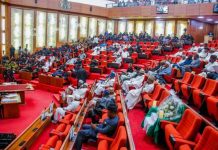



The Federal High Court in Lagos has scheduled July 20, 2026, for judgment in a suit filed by the Wireless Application Service Providers Association of Nigeria (WASPAN) against the Federal Competition and Consumer Protection Commission, FCCPC, over the introduction of consumer lending regulations.
It was learned that Justice A.L. Allagoa reserved judgment after lawyers for both parties adopted their final written addresses in the suit marked FHC/L/CS/760/2026 at the court’s Ikoyi division on Monday.
The case revolves around the legality of the Digital, Electronic, Online and Non-traditional Consumer Lending Regulations also called the DEON Regulations issued by the FCCPC.
The proceedings centered on the powers of the FCCPC in Nigeria’s digital economy and telecommunications sector.
The parties were not in court but were represented by Kemi Pinheiro SAN, Chukwudi Enebeli SAN, Muyiwa Odubela and Pelumi Agbeyo for WASPAN, and Olufunke Aboyade SAN for the FCCPC with A. Aribisala, B. Alexander and I.M. Balogun.
At the outset of proceedings lawyers told the court that matters relating to earlier contempt proceedings had been resolved amicably.
The plaintiff then withdrew its Form 49 contempt proceedings commenced by it prior to the update and the application was struck out.
The hearing then moved to the preliminary objection of the FCCPC challenging the competence of the suit.
Aboyade, arguing the objection, said the DEON Regulations had been in operation since July 2025 and questioned why the action was only filed recently.
She said the regulations were designed to protect consumers and WASPAN had not followed mandatory statutory pre-action notice requirements before going to court.
Pinheiro, however, urged the court to throw out the objection, saying the FCCPC introduced disputed facts without affidavit evidence to back them up.
He said issues concerning delay as well as alleged procedural non-compliance could not competently be raised by way of written submissions alone.
The senior advocate further argued that constitutional rights affording access to court would override technical objections relating to pre-action notices where a party alleges imminent regulatory injury.
Pinheiro also accused the FCCPC of taking contradictory legal positions, by challenging the jurisdiction of the court, but at the same time seeking affirmative relief from the same court.
On the substance, WASPAN asked the court to nullify portions of the DEON Regulations, insisting that the FCCPC overstepped its statutory powers.
The plaintiff submitted that although the FCCPC has powers to make regulations under its enabling law, such powers are limited to consumer protection matters and cannot override sector-specific laws governing telecommunications and financial services.
Mr. Pinheiro specifically argued that the FCCPC was trying to exercise powers already vested in the Nigerian Communications Commission, NCC, and the Central Bank of Nigeria, CBN.
He further argued that subsidiary legislation cannot override Acts of the National Assembly, maintaining that the disputed regulations are in conflict with provisions of the Nigerian Communications Act and the Central Bank of Nigeria Act.
In defence of the regulations, the FCCPC maintained that its statutory powers cut across sectors where issues of consumer rights and market competition arise.
Aboyade also argued that defendants in originating summons proceedings are entitled to raise and argue independent legal issues in response to claims before the court.
In final exchanges, WASPAN urged the court to discount documentary exhibits tendered by the FCCPC, saying that the materials lacked evidential value and did not establish any direct link between alleged loan shark activities and members of the association.
Justice Allagoa after hearing arguments from both sides adjourned the matter till July 20 for judgment.
This is another opportunity to own a faster-loading website to expand your business and take it digitally online. Meet the best website designer/master coder for any kind of website. Contact them now it is affordable Chat now: 09077260922
ALAGA360.COM.NG Advertisement Rate CardReach Thousands of Readers Across Nigeria and Beyond
Display Advertisement Rates
| Advertisement Type | Size | Duration | Price |
|---|---|---|---|
| Homepage Banner | 728 × 90 px | 1 Week | ₦30,000 |
| Homepage Banner | 728 × 90 px | 1 Month | ₦100,000 |
| Sidebar Banner | 300 × 250 px | 1 Month | ₦50,000 |
| Sponsored Article | Full Page | Permanent | ₦50,000 |
| Featured News Publication | Full Article | Per Post | ₦20,000 |
| Event Promotion | Article + Banner | 1 Week | ₦40,000 |
| Political Campaign Coverage | Article + Interview | Per Package | ₦100,000 |
| Business Profile Feature | Full Article | Permanent | ₦75,000 |
| Social Media Promotion | All Platforms | Campaign | Contact Us |
Special Advertising Packages
🥉 Bronze
- ✔ 1 Sponsored Article
- ✔ 1 Month Sidebar Banner
- ✔ Social Media Promotion
🥈 Silver
- ✔ 2 Sponsored Articles
- ✔ Homepage Banner (1 Month)
- ✔ Social Media Promotion
- ✔ Interview Publication
🥇 Gold
- ✔ Unlimited News Coverage
- ✔ Homepage Banner
- ✔ Featured Interview
- ✔ Social Media Campaign
- ✔ Event Coverage