






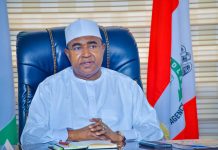
Joseph Tegbe, Nigeria’s new Minister of Power, has cautioned Nigerians against expecting an instant improvement in the country’s energy supply, claiming that the problems facing the industry are the product of decades of neglect and cannot be fixed in a few of months.
Speaking at the Presidential Villa in Abuja following President Bola Tinubu’s inauguration, Tegbe recognized consumer dissatisfaction but insisted that continuous improvements are starting to show results throughout the electrical value chain.
His comments coincide with the fact that, despite numerous government initiatives and large investments in the industry, households and businesses still struggle with unstable power supplies.
According to Tegbe, the administration is concentrating on resolving fundamental flaws in the production, transmission, and distribution of electricity, emphasizing that significant and long-lasting improvements would necessitate perseverance, consistent policy implementation, and continuous investment.
The difficulties that have prevented this industry from reaching its full potential have existed for decades. In weeks or months, they won’t be completely undone, the minister stated.
“I will not promise what I cannot deliver, but I promise visible improvement as you have been seeing, and I will continue to communicate honestly with you at every stage,” he continued.
The minister disclosed that after being confirmed by the Senate, he has consulted with key players in the electricity industry and created a plan to enhance execution, increase accountability, and provide quantifiable outcomes.
He claims that while talks with foreign development partners have created new chances for financial help, industry operators and agencies have shown a willingness to support the government’s goals.
Additionally, we have had fruitful conversations with funding partners and foreign development organizations who have indicated a readiness to support the power industry with liquidity. Tegbe stated, “This is a major vote of confidence in the direction of our reforms.”
The minister cited recent changes in the industry to bolster his optimism. Among these is the Niger Delta Power Holding Company’s restoration of the 450 megawatt Alaoji Open Cycle Power Plant in Abia State following a three-year hiatus. He claimed the plant can currently transmit up to 375 megawatts to the national grid.
He also mentioned the Transmission Company of Nigeria’s energization of new transmission facilities in the states of Abuja, Oyo, and Ogun, characterizing the initiatives as crucial measures toward enhancing grid stability and lowering network bottlenecks.
Tegbe went on to mention that after a 100MVA transformer failed, areas of Abuja had their electrical supply restored in less than a day. He said that this prompt action demonstrated increased operational efficiency in the industry.
Regarding consumer protection, the minister emphasized the Nigerian Electricity Regulatory Commission’s recent order mandating that distribution companies reimburse qualified Band A customers who were impacted by power shortages earlier in the year.
He claims that the ruling shows how committed the government is to maintaining accountability and safeguarding consumers while changes are ongoing.
Tegbe emphasized that the Tinubu administration is still dedicated to increasing access to dependable electricity and building a power sector that can sustain economic expansion, industrial development, and job creation in spite of the obstacles that lie ahead.
“Reliable and reasonably priced electricity for all Nigerian homes, businesses, and industries, 24/7,” he declared.
“That trip is somewhat lengthy. However, under President Tinubu’s Renewed Hope Agenda, we are definitely moving in the right direction. We’re going to keep going. Deliveries will continue. And improvements will continue to be made.
On April 30, President Tinubu proposed Tegbe as minister of power, and a week later, the Senate approved his nomination. His nomination puts him at the forefront of one of the administration’s most important reform initiatives, and there are strong hopes that long-term gains in the supply of energy could boost investor confidence and generate more significant economic growth.
This is another opportunity to own a faster-loading website to expand your business and take it digitally online. Meet the best website designer/master coder for any kind of website. Contact them now it is affordable Chat now: 09077260922
ALAGA360.COM.NG Advertisement Rate CardReach Thousands of Readers Across Nigeria and Beyond
Display Advertisement Rates
| Advertisement Type | Size | Duration | Price |
|---|---|---|---|
| Homepage Banner | 728 × 90 px | 1 Week | ₦30,000 |
| Homepage Banner | 728 × 90 px | 1 Month | ₦100,000 |
| Sidebar Banner | 300 × 250 px | 1 Month | ₦50,000 |
| Sponsored Article | Full Page | Permanent | ₦50,000 |
| Featured News Publication | Full Article | Per Post | ₦20,000 |
| Event Promotion | Article + Banner | 1 Week | ₦40,000 |
| Political Campaign Coverage | Article + Interview | Per Package | ₦100,000 |
| Business Profile Feature | Full Article | Permanent | ₦75,000 |
| Social Media Promotion | All Platforms | Campaign | Contact Us |
Special Advertising Packages
🥉 Bronze
- ✔ 1 Sponsored Article
- ✔ 1 Month Sidebar Banner
- ✔ Social Media Promotion
🥈 Silver
- ✔ 2 Sponsored Articles
- ✔ Homepage Banner (1 Month)
- ✔ Social Media Promotion
- ✔ Interview Publication
🥇 Gold
- ✔ Unlimited News Coverage
- ✔ Homepage Banner
- ✔ Featured Interview
- ✔ Social Media Campaign
- ✔ Event Coverage