




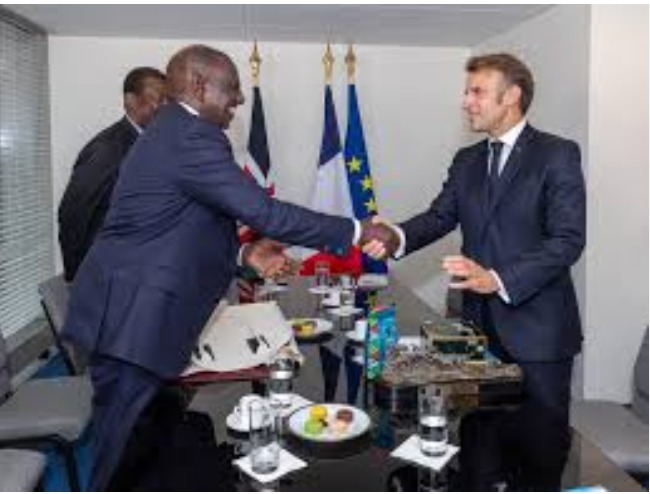

French President, Emmanuel Macron and his Kenyan counterpart, William Ruto, cohosted the Africa Forward Summit in Nairobi, the capital city of Kenya with the aim of rebuilding relations between France and African countries. Michael Olugbode in this report, attempts to put into perspective what the meeting means to France and Africa, today and in the future.
Relations between France and Africa have remained among the most complex, controversial and strategically important international relationships in the world for more than six decades after formal decolonisation. From colonial endeavor it grew into political alliances, military partnerships, economic dependence, cultural exchanges and, in recent years, increasingly bitter disputes over sovereignty and influence.
But now that relationship seems to be at another crossroads.
In Nairobi, Kenya, at the Africa Forward Summit co-hosted by Emmanuel Macron and William Ruto, African and European leaders discussed how to reshape the future of Africa-France relations, using language of equality, co-investment, sovereignty and shared prosperity.
The summit had symbolic importance. For the first time, the traditional Africa-France summit was held in a major Anglophone African country, not a Francophone former French colony. That in itself was a conscious change in French policy towards Africa.
But beyond the optimistic rhetoric of partnership lies a deeper historical question: can France really establish a new relationship with Africa without coming to terms with the enduring legacies of “Françafrique”?
Loaded with the Past
To grasp France’s relation with Africa, one cannot ignore colonialism and the post-independence system which followed.
Following independence movements of the 1950s and 1960s, France retained enormous political, military and economic influence over many of its former colonies in West and Central Africa. Paris maintained what became known as “Françafrique” – an informal system of influence that critics described as neo-colonial – through military agreements, monetary arrangements such as the CFA franc, control of strategic resources and elite political networks.
For decades France had intervened militarily in African states, supported friendly governments, influenced political transitions and protected economic interests. French companies dominated everything from oil and mining to telecommunications and infrastructure.
For many Africans, especially younger generations, the relationship seemed more and more unequal. France was often seen not as a partner but as the keeper of old structures that preserved dependence.
Anti-French sentiment has grown in parts of West Africa in recent years, particularly in Mali, Burkina Faso and Niger, where military juntas have pushed out French troops and challenged France’s decades-old role in regional security.
The shift in political mood is why the Nairobi summit was not just diplomacy but an attempt at political reinvention.
Macron’s Push to Redefine France-Africa Relations
At the summit, President Macron openly admitted that France’s traditional policy towards Africa was no longer tenable.
“For too long,” he said, “too many people… saw Africa as their back yard. That is done.”
That statement may have been the most candid admission ever made by a French president about France’s historic posture toward Africa.
In speeches in Nairobi, Macron repeatedly said Africa does not want charity, paternalism or lectures from Europe.
“We don’t want the African continent to come and give us aid,” he said. “People in Africa want us to come and invest.
At the summit, Macron outlined the future relationship in four broad concepts as follows:
equality; co-investment; sovereignty; and reciprocal strategic interests.
“The future prosperity and strategic autonomy of Europe increasingly depends on the success of Africa,” he said.
“Our success is contingent on supporting your success,” he said.
The language marked a departure from older diplomatic frameworks in which Africa was often treated as the recipient of aid, humanitarian assistance or security intervention.
Instead, Macron kept talking about Africa as “the continent of the present”, a land of innovation, and a key partner in technology, energy, industrialisation and artificial intelligence.
The summit also yielded concrete economic pledges, including 23 billion euros of investments for Africa — 14 billion euros from French firms and 9 billion euros from African investors.
Why Africa Is No Longer Waiting on Europe
This change of tone in France is not coming out of nowhere. And Africa itself has been transformed massively.
It’s also the youngest continent in the world, and the most urbanised and technologically connected. African governments are diversifying partnerships with China, Turkey, India, Gulf states and Russia. Today, no outside power dominates Africa.
In particular, China’s rise changed Africa’s diplomatic landscape. Chinese investment in infrastructure, mining, manufacturing and telecommunications tipped the balance of influence that used to be the preserve of France and other European powers.
Macron himself recognised this shift in Nairobi, saying that China, Turkey and the United States had become tougher competitors in Africa because they were often seen as more commercially aggressive and competitive.
At the same time, African leaders are more assertive in their calls for reforms in global governance, financing and trade systems.
This was strongly underscored in the intervention of President Bola Tinubu at the summit.
Tinubu’s Intervention Africa Requires Fairness, Not Charity
President Tinubu’s presence in Nairobi was a sign of the widespread African discontent with the world economic order.
He said Africa’s industrialisation and development are constrained by unfair financial structures, punitive borrowing costs and weak investment mechanisms.
Tinubu said African countries are being categorized as permanently ‘high risk’ economies and that it is very difficult to access affordable finance.
He said Nigeria alone would be expected to spend $11.6 billion on debt servicing by 2026 – almost half the government revenue.
His intervention echoed closely the themes raised by Macron and Ruto: reform of the global financial architecture; support for industrialisation; and enhanced African economic integration.
“Africa must stop exporting raw materials and start manufacturing and regional industrialisation,” Tinubu said.
It echoed Macron’s own argument that Africa should not be a mere exporter of raw minerals and commodities while the industrial processing took place elsewhere.
Tinubu also highlighted Nigeria’s maritime aspirations, and pitched the country’s Deep Blue maritime security project as a regional platform for Gulf of Guinea cooperation.
His larger message was important: Africa is not asking for sympathy; it is asking for equal participation in the global economy.
This is a profound change in Africa’s international diplomacy.
Trust: The Essential Contradiction
But even if the rhetoric in Nairobi is optimistic, France-Africa relations are still plagued by a fundamental problem: trust.
Many Africans are wary of France’s intentions. Online discussions during the summit revealed residual suspicion about whether France’s new strategy is really different from older patterns of influence. Some commentators accused France of merely moving its focus from hostile Francophone countries to more receptive Anglophone countries such as Kenya.
Others asked if investment-led engagement could become a new form of economic dependency rather than true partnership.
These concerns are not without merit.
True partnership is about more than speeches and investment announcements. It needs to be rejigged.
Africa’s future relationship with France – and indeed with Europe generally – must accordingly be founded on several principles.
What the Future Relationship Should Be
From Extraction to Industrialisation Africa must stop being mainly an exporter of raw materials. The continent has essential minerals critical to global energy transition, digital technology and manufacturing. But a lot of the value addition is still done outside Africa.
Future relations between France and Africa should focus on: local production; industrial parks;
technology transfer; African ownership within supply chains.
Macron was blunt about this reality, noting that Africa should not just be “where raw materials… are extracted but also where processing takes place.” That’s probably the most important economic question of the next generation.
Investment Reform and Financial Justice
Despite their huge growth potential, African countries still face disproportionately high borrowing costs.
Tinubu’s focus on financial reform highlighted the urgency of the matter.
If France really wishes for a new partnership with Africa, it must support: fairer sovereign risk assessments; lower financing barriers;
stronger development banks; and financial institutions owned by Africans.
Macron’s support for strengthening the guarantee mechanism of the Nairobi-based ATIDI could be one step in that direction.
Sovereignty Respect
France’s image in Africa was badly damaged by military interventions and political interference.
Future relations must be based on non-interference, mutual respect and African leadership in security matters.
The Nairobi Declaration had stressed strongly that the principal actors in settling African conflicts must be Africans.
That principle is crucial.
Human Capital, Youth and Technology
Africa’s biggest asset is its people, not oil, gold or lithium.
Youth, innovation, digital technology, AI, sports and creative industries were recurring themes of the summit as both African and European leaders know that the continent’s demographic strength could be turned into a global economic engine.
The future role of France should therefore be concentrated on: education partnerships; research collaboration; digital infrastructure;
financing entrepreneurship; and mobility for African students and professionals.
A Relationship Over and Beyond Colonial Memory
History cannot be erased, but it need not forever imprison the future.
France needs to keep dealing honestly with the worst sides of its colonial experience, and African governments need to be pragmatic about new opportunities.
You cannot build the future on resentment, and you cannot build it on denial.
What Africa increasingly seeks is dignity, reciprocity and respect.
Defining Transition
The Africa Forward Summit might be recalled as the time when France publicly acknowledged that the old order in Africa was finished.
“It’s done,” Macron himself said.
But declarations alone will not reset the relationship.
The real test will be whether investments turn into real partnerships, financing becomes fairer, African industries become stronger and sovereignty is respected in practice, not only in rhetoric.
“Africa is no longer a passive actor in global affairs today. It is more and more confident, assertive and strategic.
France can either adapt to this new Africa as an equal partner — or keep losing influence to countries that understand the changing realities more quickly.
The future of France-Africa relations will thus not be decided in Paris alone.
It will increasingly be defined in Nairobi, Abuja, Kigali, Lagos, Dakar, Johannesburg and across a continent that’s no longer waiting to be spoken for.
This is another opportunity to own a faster-loading website to expand your business and take it digitally online. Meet the best website designer/master coder for any kind of website. Contact them now it is affordable Chat now: 09077260922
ALAGA360.COM.NG Advertisement Rate CardReach Thousands of Readers Across Nigeria and Beyond
Display Advertisement Rates
| Advertisement Type | Size | Duration | Price |
|---|---|---|---|
| Homepage Banner | 728 × 90 px | 1 Week | ₦30,000 |
| Homepage Banner | 728 × 90 px | 1 Month | ₦100,000 |
| Sidebar Banner | 300 × 250 px | 1 Month | ₦50,000 |
| Sponsored Article | Full Page | Permanent | ₦50,000 |
| Featured News Publication | Full Article | Per Post | ₦20,000 |
| Event Promotion | Article + Banner | 1 Week | ₦40,000 |
| Political Campaign Coverage | Article + Interview | Per Package | ₦100,000 |
| Business Profile Feature | Full Article | Permanent | ₦75,000 |
| Social Media Promotion | All Platforms | Campaign | Contact Us |
Special Advertising Packages
🥉 Bronze
- ✔ 1 Sponsored Article
- ✔ 1 Month Sidebar Banner
- ✔ Social Media Promotion
🥈 Silver
- ✔ 2 Sponsored Articles
- ✔ Homepage Banner (1 Month)
- ✔ Social Media Promotion
- ✔ Interview Publication
🥇 Gold
- ✔ Unlimited News Coverage
- ✔ Homepage Banner
- ✔ Featured Interview
- ✔ Social Media Campaign
- ✔ Event Coverage