




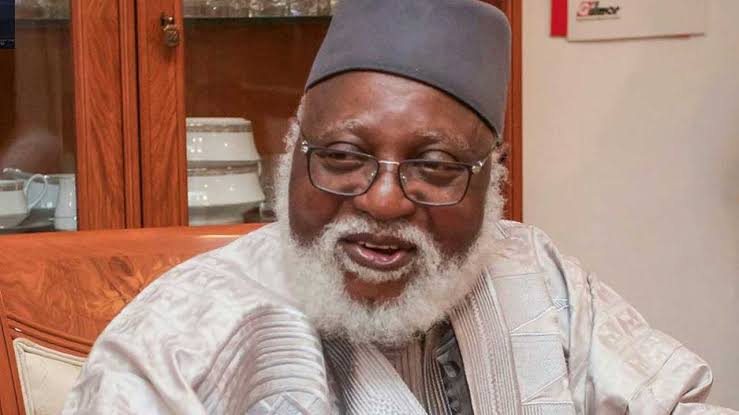


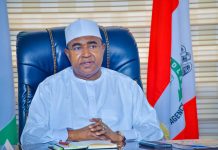
Former Head of State, General Abdulsalami Abubakar (retd), said the 1979 Constitution was adopted with amendments in 1999 to prevent military “hawks’’ from stalling Nigeria’s return to democracy after the death of General Sani Abacha.
He detailed in his autobiography, Call of Duty, how some officers sought a lengthy transition that might have kept the military in power for years under the pretext of writing a new constitution.
He said after he took office on June 8, 1998, following the death of Abacha, he made it his priority to get out of military rule as quickly as possible.
“I figured the longer the Military remained in power after Abacha’s death the dimmer the prospects of a credible transition to democracy would be,” he said.
“Some of the military officers had tasted political power and were not too willing to let go. If I extended the transition programme under the wish to have a perfect democracy with a perfect Constitution, I would only be giving space to the hawks in the Military to hang on to power.”
He said: “I could not even rule out the possibility of a coup along the line by officers who did not want the Military to quit. For me, the earlier we left, the better for the democratisation project.
Abdulsalami said one option was to start the transition all over again, which could have prolonged military rule until 2001.
“This was the choice of those who wanted the Military to stay longer. It would enable us to buy time by creating a public debate for one year, establishing a conference that would sit for another one year to write a new constitution, and then releasing a timetable that would run for another year,” he said.
He rejected the option, however, saying there was no “perfect” moment for democracy.
“Democracy is not built in a day. “Plant the seed and it will continue to grow if the players are willing to water it.”
He also rejected the continued use of Abacha’s transition plan, saying political parties lacked credibility.
“The five political parties, which the late Chief Bola Ige famously described as the ‘five fingers of a leprous hand’, had no credibility. “They were seen as playthings in the hands of Abacha,” he said.
A proposal for an interim government was also rejected after the collapse of a similar arrangement in 1993.
On constitutional choice, Abdulsalami said a 25-member committee led by Justice Niki Tobi recommended retention of the 1979 Constitution with amendments instead of the 1995 draft.
“I have to admit this was a relief to me,” he said.
“For someone who wanted to get the transition programme done with as quickly as possible, I was quite comfortable with adopting the 1979 Constitution.
This is another opportunity to own a faster-loading website to expand your business and take it digitally online. Meet the best website designer/master coder for any kind of website. Contact them now it is affordable Chat now: 09077260922
ALAGA360.COM.NG Advertisement Rate CardReach Thousands of Readers Across Nigeria and Beyond
Display Advertisement Rates
| Advertisement Type | Size | Duration | Price |
|---|---|---|---|
| Homepage Banner | 728 × 90 px | 1 Week | ₦30,000 |
| Homepage Banner | 728 × 90 px | 1 Month | ₦100,000 |
| Sidebar Banner | 300 × 250 px | 1 Month | ₦50,000 |
| Sponsored Article | Full Page | Permanent | ₦50,000 |
| Featured News Publication | Full Article | Per Post | ₦20,000 |
| Event Promotion | Article + Banner | 1 Week | ₦40,000 |
| Political Campaign Coverage | Article + Interview | Per Package | ₦100,000 |
| Business Profile Feature | Full Article | Permanent | ₦75,000 |
| Social Media Promotion | All Platforms | Campaign | Contact Us |
Special Advertising Packages
🥉 Bronze
- ✔ 1 Sponsored Article
- ✔ 1 Month Sidebar Banner
- ✔ Social Media Promotion
🥈 Silver
- ✔ 2 Sponsored Articles
- ✔ Homepage Banner (1 Month)
- ✔ Social Media Promotion
- ✔ Interview Publication
🥇 Gold
- ✔ Unlimited News Coverage
- ✔ Homepage Banner
- ✔ Featured Interview
- ✔ Social Media Campaign
- ✔ Event Coverage